
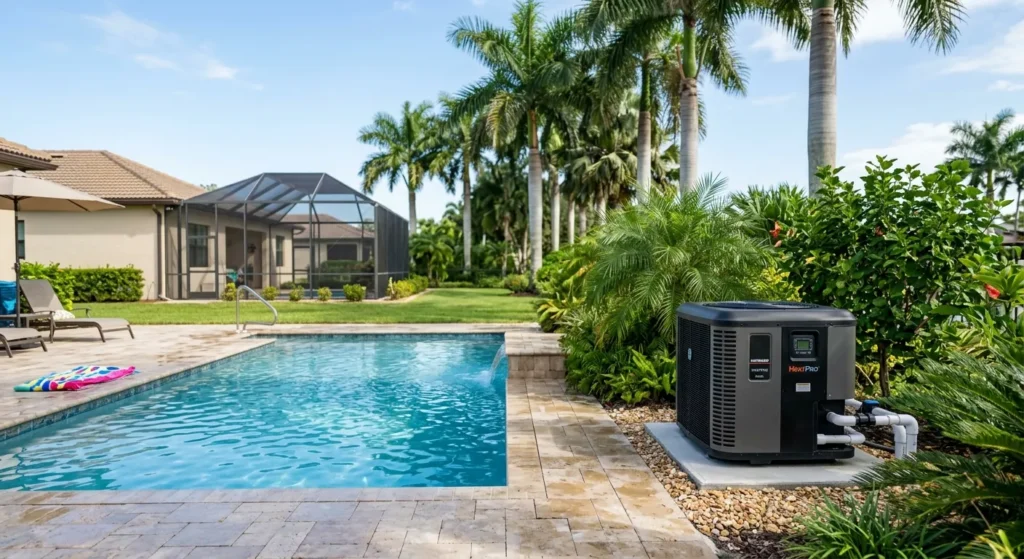
Living along Florida’s Space Coast gives homeowners and commercial property managers a distinct advantage: pleasant weather for most of the year. However, when the coastal breeze picks up during late autumn and winter, pool water temperatures drop rapidly. Investing in professional pool heat pump maintenance ensures your aquatic heater operates at peak thermal performance, protecting your utility budget while keeping your pool comfortable standard year-round.
How Maintenance Saves Energy and Keeps Pools Warm
Regular maintenance on your heat pump lowers energy bills by keeping the system’s heat exchangers, air coils, and electrical components free from buildup, corrosion, and refrigerant leaks.
In Brevard County, airborne salt spray, humidity, and debris constantly degrade heating efficiency. By scheduling yearly maintenance, your heat pump consumes significantly less electricity, transfers ambient heat far more effectively into your water, and prevents unexpected downtime during chilly spells.
| Key Maintenance Task | Primary Energy Benefit | Local Brevard Impact |
| Evaporator Coil Rinsing | Restores optimal airflow and heat transfer | Removes ocean salt spray and sand buildup |
| Refrigerant Level Inspection | Keeps compressor running at rated efficiency | Prevents long cycle times during cold snaps |
| Electrical & Contact Checks | Prevents voltage drops and overheating | Protects against coastal humidity corrosion |
| Water Flow & Filter Calibration | Maintains ideal heat-exchange rate per gallon | Keeps water chemistry from eroding internal titanium |
How Pool Heat Pumps Work in Winter
Understanding how pool heat pumps work in winter helps clarify why ongoing maintenance is so important for Space Coast homeowners.
Unlike traditional gas or electric resistance heaters that generate heat directly, a heat pump acts as a reverse air conditioner. It pulls existing heat from the outside air, compresses it to elevate the temperature, and transfers that thermal energy into the pool water through a titanium heat exchanger.
[ Ambient Air ] > [ Evaporator Coil Extracts Heat ] > [ Compressor Elevates Temp ] > [ Heat Exchanger Heats Pool Water ]During cooler months, ambient heat levels in Brevard County drop. The unit must process a higher volume of air to extract the same amount of heat. If the evaporator coils are clogged with coastal grime or salt crust, the heat pump struggles to extract heat, causing the compressor to run longer and consume significantly more electricity.
Understanding How Pool Heat Pump Maintenance Saves Energy
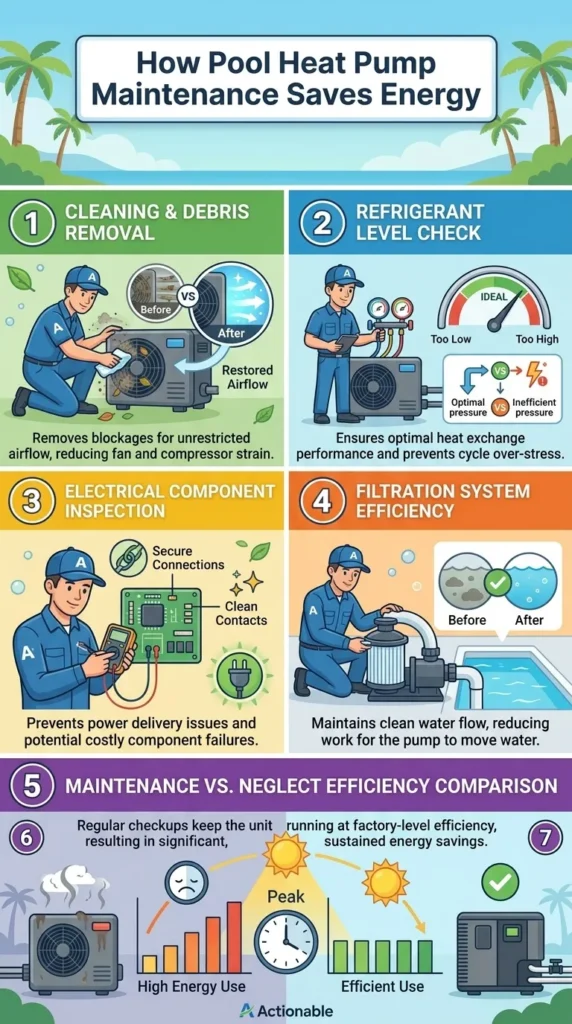
When discussing how pool heat pump maintenance saves energy, the main factor is coefficient of performance (COP). A well-maintained heat pump typically operates at a COP between 5.0 and 6.0, meaning it produces five to six units of heat energy for every unit of electricity consumed.
When maintenance is neglected, system COP drops rapidly due to several issues:
-
- Restricted Airflow: Dirt, leaves, and salt deposits on the outer coils force the fan motor and compressor to work harder, pulling higher amperage.
-
- Refrigerant Imbalance: Slight leaks mean the system must run twice as long to achieve the target water temperature.
-
- Titanium Exchanger Scale: Chemical imbalances create scale inside the heat exchanger, acting as an insulator that blocks heat from reaching the water.
By scheduling routine precision tune-ups with certified technicians, you maintain peak COP levels and avoid unnecessary spike charges on your FPL power bills. Learn more about keeping your system running smoothly by visiting our dedicated Pool Heat Pump Repair & Service page.
Specialized HVAC & Environmental Services for Brevard County
Keeping your home and property comfortable year-round requires more than just pool heating. A comprehensive thermal management strategy balances indoor air quality, climate control, and exterior heating efficiency.
Commercial HVAC Systems
For resorts, homeowners associations (HOAs), fitness facilities, and commercial properties in Titusville, Melbourne, and Palm Bay, commercial HVAC and heating efficiency are essential operating priorities. Our team delivers large-scale maintenance, commercial chiller care, and preventative service plans engineered for high-demand Florida environments. Explore our full suite of solutions on our Commercial HVAC service page.
Smart Thermostats & Automation
Modern pool heat pumps integrated with smart home controllers and indoor HVAC smart thermostats allow homeowners to schedule heating around real-time weather forecasts and off-peak energy rates. Discover how upgrading your controls can save money on our Smart Thermostats page.
Duct Repair & Air Sealing
Indoor comfort relies on leak-free ductwork. Leaky ducts waste up to 30% of conditioned air, forcing your central air conditioner to run continuously. Combining indoor duct restoration with outdoor heat pump maintenance lowers total household utility bills. See how we optimize indoor airflow on our Duct Repair page.
Actionable Pool Heat Pump Efficiency Tips
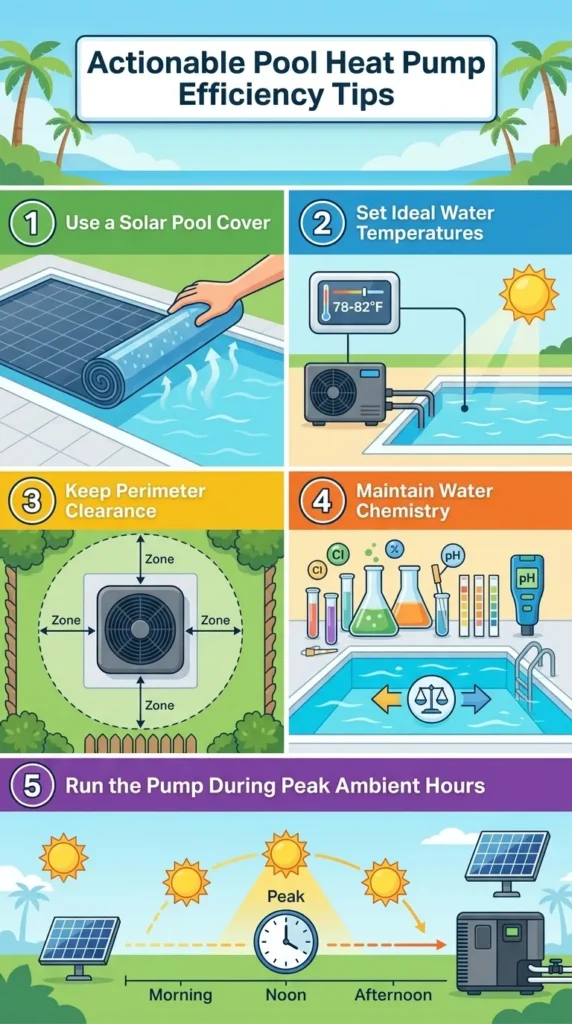
To maximize your system’s performance and extend your heating budget, combine professional servicing with these daily operational practices:
-
- Use a Solar Pool Cover: Extending pool season with heat pump assistance is vastly easier when using a liquid or physical pool blanket. Evaporation accounts for over 70% of pool heat loss.
-
- Set Ideal Water Temperatures: Maintain water between 78°F and 82°F during winter. Raising the temperature to 85°F or higher increases energy usage by up to 10% to 30% per degree.
-
- Keep Perimeter Clearance: Ensure at least 24 inches of clearance around the heat pump and 5 feet above it to prevent recirculating cold discharge air.
-
- Maintain Water Chemistry: Keep pH between 7.4 and 7.8 and total alkalinity between 80 and 120 ppm to prevent corrosion inside the titanium heat exchanger.
-
- Run the Pump During Peak Ambient Hours: Schedule heat pump cycles during the warm afternoon hours when ambient air temperatures are highest for maximum efficiency.
For year-round savings across your entire heating and cooling ecosystem, check out our general Residential AC Services.
Safety Guidelines, Operating Limits, and Local Relevance
System Operating Limits
While Florida heat pumps are highly efficient, they rely on ambient air. When ambient outdoor temperatures drop below 45°F–50°F, heat extraction efficiency decreases, and frost can form on the outdoor coils. Most modern units feature auto-defrost controls, but running a heat pump below its minimum temperature threshold can trigger emergency lockouts.
Electrical & Mechanical Safety
-
- High Voltage Danger: Pool heat pumps operate on 220V/240V circuits near body-of-water equipment. All electrical inspections, contactor replacements, and capacitor tests must be conducted by licensed HVAC/electrical professionals.
-
- Pressure Risks: Refrigerant circuits operate under high pressures. Unauthorized tampering with valves can lead to personal injury or environmental contamination.
The Brevard County Environment
From Cape Canaveral down to Sebastian Inlet, Brevard County properties experience humid, salt-rich air that accelerates metal oxidation and coil deterioration. Local homeowners benefit from specialized anti-corrosion coil coatings and scheduled rinse programs designed specifically for coastal environments.